Agent
Does the work
A general-purpose Code Mode agent writes and runs small programs, uses company context, and can build applications.
08 / REFERENCE ARCHITECTURE
Cloudflare OS explained
Cloudflare OS makes AI-created apps and agent work private, isolated, and capability-scoped. Pair it with a continuous-learning architecture and those safe actions can also become shared decisions, reusable knowledge, and better future work.
Cloudflare describes the August 2026 v2 release as capable, but still under heavy development.
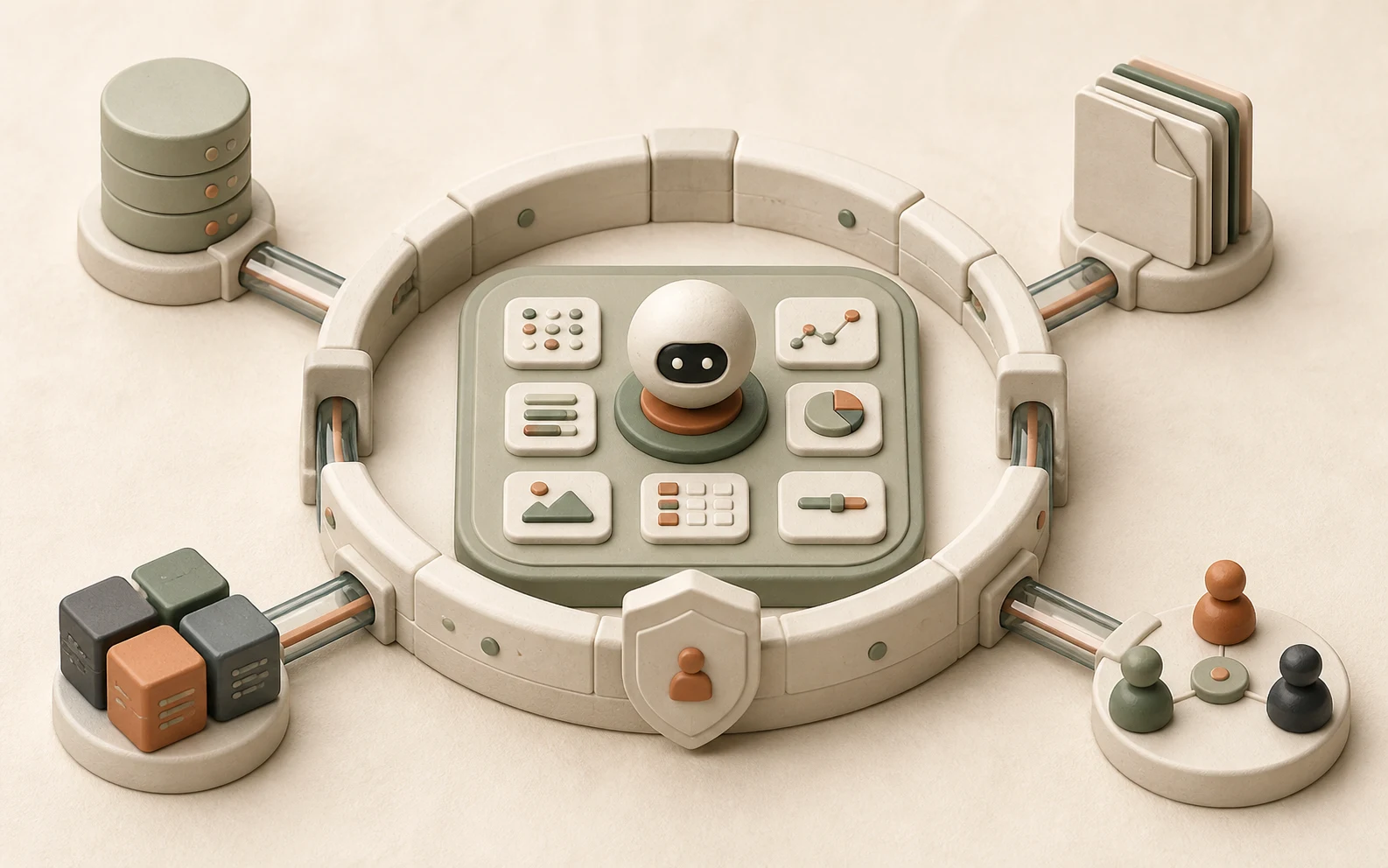
The core idea
Cloudflare uses “operating system” in two ways: a company-wide environment for productive, safe AI use—and a runtime that manages agent workloads much as a conventional OS manages processes and devices.
Agent
A general-purpose Code Mode agent writes and runs small programs, uses company context, and can build applications.
Gadget
A private, modifiable app instance runs in its own sandbox. Reusable application code can be shared as a Blueprint.
Gatekeeper
A service-specific capability layer holds credentials, narrows resource access, logs activity, and mediates side effects.
System map
Generated code is treated as untrusted. The platform—not the prompt—enforces identity, isolation, egress limits, narrow resource introductions, and approval.
Approved models · spend · rate limits · logging
OAuth · resource scope · simulation · approval · audit
Why the “OS” analogy works
The analogy is useful because it makes the trust model concrete: applications become processes, connections become device drivers, and agents need permissions that are restricted yet accountable to a person.
Architecture comparison
Cloudflare OS and the continuous-learning organization solve adjacent problems. One secures a unit of agentic work. The other decides how work becomes shared meaning and compounds across time.
Cloudflare OS
Optimize each workspace, agent, and Gadget for productive action without ambient access.
Continuous-learning organization
Route meaningful outputs into collaboration, decisions, memory, reuse, and governed reflection.
| Dimension | Cloudflare OS | Continuous-learning organization | Combined architecture |
|---|---|---|---|
| Primary question | How can people and agents safely build and use software? | How does relevant work become shared understanding and better future action? | How can safe action become governed learning? |
| Core unit | User · workspace · agent · Gadget | Individual · team · organization | Bounded workspaces connected by policy |
| Trust boundary | Sandbox · binding · Gatekeeper · approval | Router · audience · authority · knowledge scope | Capabilities govern access; routers govern meaning |
| Human role | Grant resources and approve side effects | Interpret, decide, correct, and teach | Authorize action and shape what is learned |
| Knowledge over time | Workspace state, company context, observed-resource lineage | Memory, cache, and governed “dreaming” | Operational state feeds reusable organizational knowledge |
| Best at | Secure agent execution | Organizational cognition | Progressive, auditable autonomy |
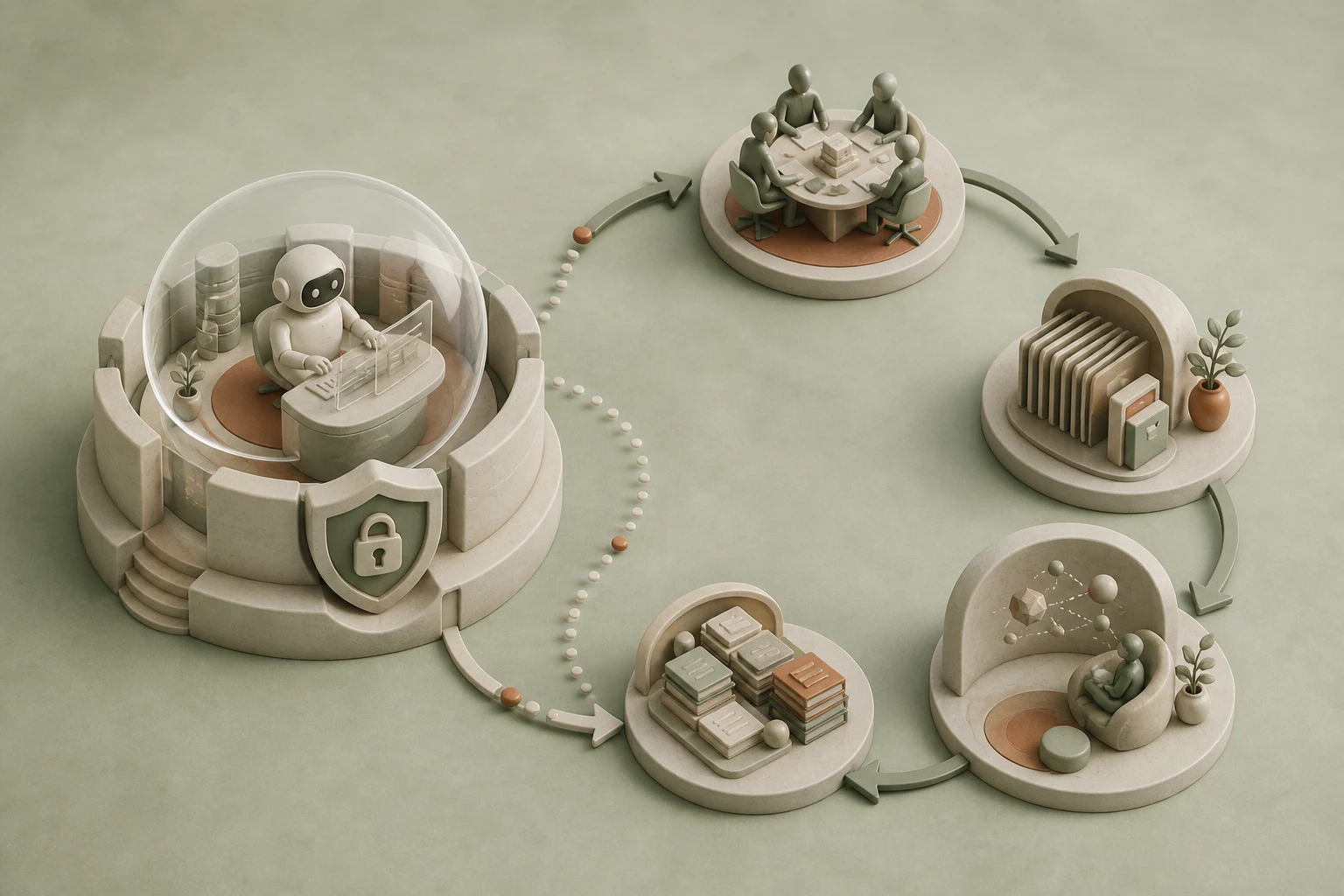
The bridge
Cloudflare OS protects the act. The learning architecture determines what should travel beyond the workspace, who should see it, what authority is required, and what should be remembered.
The combined loop
The missing link is a policy bridge between a protected workspace and organizational memory. This is where the two architectures become one operating model.
An agent works privately inside an isolated Cloudflare OS workspace.
A Gatekeeper scopes resources and simulates side effects that need approval.
The communication router surfaces decisions, risk, evidence, and exceptions.
People approve the action, correct assumptions, and add judgment.
Memory preserves, cache reuses, and governed reflection reconciles knowledge.
Better context and policy return to the next bounded workspace.
Enterprise deployment
The conceptual security model is strong; the software is still early access. A sensible enterprise adoption path keeps access narrow, environments isolated, and autonomy proportional to evidence.
No data, internet, systems, or write actions until an explicit capability is introduced.
Agents call Gatekeepers. Gatekeepers retain OAuth tokens and service credentials.
Allow observation, support preparation, and require approval for consequential execution.
Route model traffic through AI Gateway for approved providers, cost, rate, and audit controls.
Own a company deployment repo; move tested releases through dev, pilot, and production.
Record what agents observed, proposed, shared, executed, and learned—not only tool calls.
Go to the source
Start with Cloudflare’s explanation and the open-source implementation. For enterprise use, study the starter and reference architecture before connecting real systems.
The product idea, security model, Gadgets, Gatekeepers, and Workers foundation.
Read the post ↗ 02 / GITHUBThe open-source code, architecture mapping, local quick start, and early-access warning.
Inspect the repository ↗ 03 / DEPLOYMENTA deployment pattern for pinning upstream versions and owning enterprise configuration.
Open the starter ↗ 04 / REFERENCECloudflare’s reference controls for identity, orchestration, models, tools, and audit.
View the architecture ↗Independent architecture analysis based on Cloudflare’s public materials and the local Cloudflare OS architecture document. Product status noted as of August 10, 2026.